Jul
08
2008
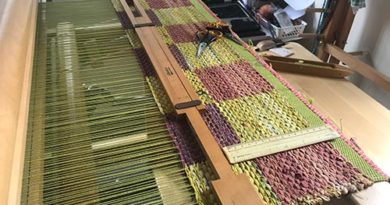
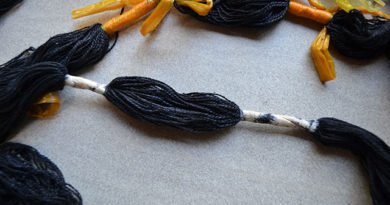
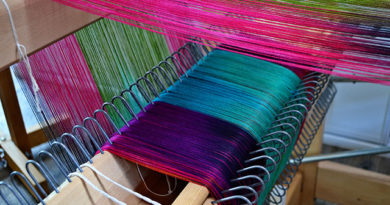
My ikat dyeing on this piece is working out great. See the little white stripes on the central warp- they are staying together much better than previously without shifting too severely. I know that a slight shifting of the threads is an inevitable and desirable feature of ikat but if they go too far off the patterning dissolves completely.
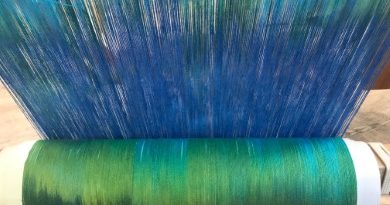
I put this success down to much better warping on my part and because it is a very narrow warp, the warping process was easier. This is the same warp that I painted in Loving that Dyeing post…so it changes colours beautifully as I weave. I guess you are wondering about the reasoning for this textile…we it is sort of under wraps and you’ll see soon. I hate keeping secrets especially about presents which is akin to this. Keep posted!
Thanks for your comments about this blog previously. It’s so encouraging to keep at it. I used to think that getting a blog up and running was pretty straight forward especially at blogger or maybe wordpress servers with that push button approach but no. Even the push button approach in its efforts to make things easier for us are actually becoming more like software that you never really understand completely. It feels daunting and only the bravest in the land web would attempt it.
Amanda is a new blogger who has done a fabulous job even on her first post. Straight into luscious weaving and interesting technique. Find her at http://sampling-sampling.blogspot.com/
My first blog entry was much more tentative. Here it is with a reference to my blog mother. The one who triggers ‘I think I’ll have a go’…. and the blog is born. There was no photo, just a nervous “hello world”.
Thursday, November 25, 2004
New Commission & New blog
I am designing a woven commission for a ‘celebration’ cloth as a wedding present. I decided to use silk as it weaves up with such luscious handle and drape.
This is also my first attempt at the blog! I have returned again and again to Sarah Bradberry’s site at www.knitting-and.com and have enjoyed it so much that I thought I’d have a go myself.
Pretty interesting! Well no, but then I don’t really think that’s the point of blogging although it is a definite plus for readers. For ourselves as craftspeople and artists it’s a public web diary of our work and thoughts with the potential for extending our community with others.
Jun
24
2008
I’m in the process of changing my web furniture around so you may ‘trip’ over some things at the moment! Hopefully it will all look better soon.
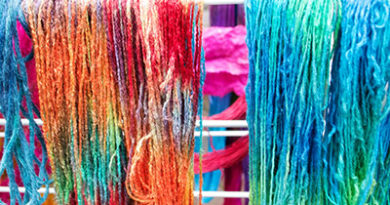
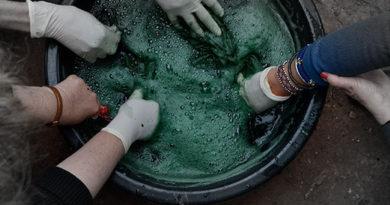
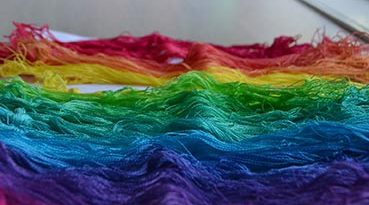
There has been a great dye workshop at the Online Guild of Weavers, Spinners and Dyers which has inspired me to revisit my dyebooks. I use fibre reactive dyes with both cellulose and protein fibres and I went through a period of trying to control my dye colours. The compilation of this dye book actually taught me about each of the dye colours I use and how much will produce the various depths of shading. Each little skein of 2/20 mercerized cotton weighed one gram. By applying different amounts of dye solution I was able to record the results. For the pale colours I had to use a syringe to measure accurately enough.
After doing all of this dyeing I now find I have a better ‘feel’ for the dye colours rather than getting down to exactness.
Jun
11
2008

The raddle is such a valuable weaving tool.
It helps to organise the warp so it can be wound on evenly. This colourful warp slid through pretty well and I find that narrow warps are much easier to beam by myself than wider ones.
I’d really like to have another person help me each time I warp but that just doesn’t happen. Firstly who has that much patience except the weaver herself. I have to order the other around because I’m in charge of the warp and who takes kindly to that. Secondly another human just isn’t always around when you need them. In the loneliness of warping I dream of helpers. I keep thinking of ingenious new ideas to streamline the operation for next time. Adding a piece of wood here and there or tieing this or that into another position. But somehow each warp seems to have different challenges and it seems like a new adventure every time.
Bonnie takes raddling a step further and uses it as a design tool.
Serendipitously, Cally has also written about raddling recently – it must be the time of year. She has actually trained her husband as a warping helper. What an inspiration.
Jun
04
2008
 |
It was good to get into dyeing again in the weekend. I’m preparing a course for the online guild in November on ‘Easy Ikat and Warp Painting”.
I’ve learnt a few tricks with warp painting over the years to make the dye process more streamlined. I used to paint the warp painstakingly along its length bit by bit but then I started painting multiple lengths of the warp at the same time. You can see in the two unpainted warp photos how I arrange the warp as I paint.
The first photo is the way I most commonly use if the whole warp is going to be the same colourway. This gets the job done quickly and efficiently but retains the ability to introduce a nice blending of different colours or shades that repeat regularly along the whole length of warp.
If I want to have multiple colourways on the same warp I use the second method. This is a really exciting application for warp painting – multiple colour bases on the one threaded warp.
I’ve included a photo of the warp when it is blended with dye by a sponge and how I begin to wrap it in plastic ready to be set aside to ‘cook’ for 24 hours. This method of dyeing on cellulose fibres such as cotton and rayon requires no heating which is why I’m so attracted to it. If I use silk with these dyes I have to apply heat/steam to set the dye.
For the workshop I’m combining these warps with a very simple ikat segment. Whilst doing some web research I re-discovered the exceptional Indonesian Textile collection site from the National Gallery in Canberra. What a resource for textile passionists everywhere. |
| Luscious warp painting |
 |
| My method for painting a single colourway |
 |
| My method for painting several colourways |
 |
| Beginning |
 |
| Ripening |
 |
May
17
2007
 |
The Online Weavers Spinners and Dyers Guild have recently completed a spinning workshop using the rare Bowmont fleeces.(See Leigh’s blog entry) Unfortunately for me, Australian Quarantine stopped my package, despite inquiries about regulations beforehand. But I didn’t miss out thanks to Beverley in the UK. She sent me a wonderful sample of spun and dyed yarn. I just had to send something in return so I crocheted an "itty bitty friendship bra". It was a cute way to show off the beauty of the fibres and Beverley’s dyeing.
The other two photos are more of my current work. Scarfs with ridges and wide plain weave selvedges. But sadly thats the end of nice photos for a while as my camera is broken. A compact flash card apparently slots into a pin system and I’ve bent them inside the camera, probably in my haste to get the tricky card in. These weaves are Tencel, silk and wool and are very luscious but have an incredible widthwise shrinkage. This means I have to weave wide to get quite narrow.
Tomorrow I start dyeing again for the next project and I’m using a few new Drimerene K colours. Like Brown! With each colour I make up a shade card using just 1gm of yarn and various strenghts to gauge colour potential. I’m finding that using the same range of colours repeatedly helps me to predict outcomes better. Dyeing makes weaving even more exciting.
|
 |
 |
 |
Apr
05
2007

Luscious chenille in chained warp mode, relaxing outside.
|
|

|
Isn’t it funny that computer and printed fonts are finally tiring the eyes. I think we’ve had enough of preset ugly borders and ‘ransom note’ style resumes and handouts. Perhaps this is why journalling is becoming so popular. Handwriting, calligraphy, doodles, drawings and blotchy colours suddenly seem fresh and inviting rather than homespun and awkward.
In this new light I prepared these notes recently for a workshop handout. I drew and wrote and painted the instructions in an old fashioned journal way. I then used computer technology to print up multiple copies but I thought it looked nice and inviting as instructions can be inaccessible and too wordy.
|
|
Thank you so much for all the comments and emails relating to my previous blog entry. Writing up a blog is very rewarding. It’s an exciting writing genre. One where you’re not alone. It’s social. It’s short. It’s reactive.It’s guarded. It’s specific. It’s evolving.
So reflecting on the grant application and its consequences I see it now [with help from readers] as it should be. I’ve realised the value of the word – evolution. Ideas evolve, and always start with little things – baby steps if you like. Maybe life is a series of multiple baby steps too. I’m starting by taking up Syne Mitchell’s Weavcast challenge to teach someone to weave. I’ve taught many people how to weave but [strangely] never on a shaft loom. My first victim eager student, Meaghan, is ready and I’m seeing her with her newly purchased 46" Leclerc Fanny 4 shaft counterbalanced loom next week.
Right now, I’m dyeing and painting warps and wefts on chenille for a small series of textiles to be woven on my 8 shaft CounterMarche loom. As Easter approaches I hope to really get a start. Hope you all have a fibery, chocolatey Easter.
|
Mar
01
2007
|
|
The dyeing part of the woven shibori process is so exciting. Look at the drab mess of tied up scarves after they come out of the final dyepot and then the unravelling in the second photo.
These particular scarves have three different dye processes on them combined with woven shibori. The first was warp painting of the tencel warp with a colourful scheme. Then dyeing the silk weft before tying with Landscape dyes. Followed by the last dye on the tied shibori which was a very dark indigo style blue and violet. The way I’m building up colour in my work lately reminds me of painting. This is the only way to get a depth of richness in colour work. In weaving the warp becomes the underpainting and can be painted in such a way that it accepts other colours on top of it, either with further dye processes or with the weft colour and/or how it is woven.
I have a lot of dyeing on the go at the moment and it takes days. But I think doing your own dyeing is so rewarding that it’s worth it. Being in Australia and having a lack of colourful yarns to choose from is also probably an advantage of sorts. We all just have to dye it ourselves.
|
|

|
|
|
| The exciting cutting of the woven shibori process. |
Jan
04
2007
|
|
The five shibori wraps that I have just woven are now going through the multiple dye processes I have planned for them.The natural 60/2 silk weft is being dyed with Landscape dyes which ONLY affect the silk and not the tencel warp.
As you can see in the photos I’m now pulling up the shibori threads for the next cellulose fibre reactive dye bath. All this dyeing is very exciting and colourful.
With one of the wraps I’ve bypassed the second dyeing altogether and put the shibori tied piece directly in the Landscape dyebath to see how it goes. This means that the shibori will only affect the silk weft threads but leave the warp colours and some of the natural silk intact.
|
| Shibori with purple cross dye on silk |
|
|
| Shibori with green cross dye on silk |
Nov
08
2006
My 8 shaft floor loom is on the move again. This time with a ribbed weave. Five scarves of warp painted 2/20 mercerised cotton with a 2/60 silk weft.
I seem to be unwinding alot of skeins lately ready for the warping process. But I’ve developed some smart ideas! When I use an immersion dye method on any skeins they are so ‘tangly’ to unwind. So I am now weaving with the yarn undyed then cross dyeing after I have finished the weaving. To maintain the clarity of the warp painting the undyed yarn must be one type of fibre and the painted yarn another type.Silk can be dyed with a fibre reactive for protein fibres which won’t affect the cotton warp.
There’s alot of room for experimentation with cross dyeing, and I think it can be more productive for a small weaving studio operation as winding and unwinding skeins takes up so much time.
Also, The Thread Project site has posted up a photo of the 49 cloths in St Pauls Chapel for the 9/11 memorial. They look spectacular hanging from the balconies. This rewarding project is also documented by webcast on the St Pauls site. Click on Thread Project to see an overview of the project by Terry Helwig.
Oct
22
2006
Here are the photos of the watermark fabric which was originally green and blue but now overdyed to create a more subtle cloth. I’m pleased with this cloth.. Being a silk it drapes beautifully.
I always have a bit of trouble with silk. After dyeing with Fibre Reactive dyes (Drimerene K) it looses its handle and becomes hard. I’ve tried boiling it in soapy water to get rid of any residue before dyeing but its not alot better. I then read that the stiff feel after weaving silk is normal and a few minutes in a warm dyer or lots of handling will soften it up.
This worked and the silk fabric now has a soft, silky feel.
I’m now busily dyeing up my next three projects which will produce 15 scarves and stoles with various techniques. Two different types of woven shibori combined with pre-painted warps and a ridged warp-wise fabric. I’m also keen to use cross-dyeing and over-dyeing again as it produces such exquisite results.I’m using a bit of tencil again to see how it shapes up in the designs. In one of the warps I used a blue rayon yarn every 4th warp. This should bring another dimension to the dyeing and look of the textile.
Also check out Becky’s Vavstuga for mini video tutorials on weaving. They are very effective and informative way of presenting weaving techniques.