Apr
23
2009
Australia seems to have lots of ‘big’ things. Like the Big Banana, the Big Pineapple, the Big Merino, and now, it seems, the Big Spindle! Look what I found on a walk along the beaches in Port Macquarie, New South Wales. Just because I’m excited about everything textilley I really do expect some sort of merriment and fanfare around such delights. At least a leader thread to start the spinning off, fluttering in the wind. But no one was in sight. The spindle was left on its own acting like a passive sculpture or monument.
I don’t know the history of this work but it must be a handspindle in giant form. I imagine textile parties with spinners and weavers and small children running around with threads and yarn.
Do you think my imagination is running away to unreality land? Probably, well definitely, but wouldn’t it be nice to celebrate yarn and what it does for us. I’m heading up to Port every chance I get just to visit this fantasy. Oh well back to the land of hum drum.
Oct
03
2008
Can it be possible that a square rather than round spindle will spin? Well yes, and spin for a longer time.
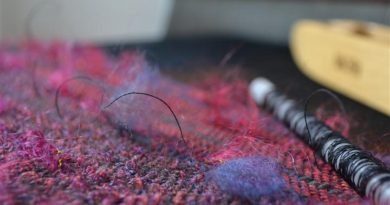
I just bought this spindle from UK Spindlemaker Michael Williams. I have been wanting to buy a special spindle for a long time…but not having access to trying any I have to depend on reviews from those I respect as spinners and women of the yarn. I had heard rave reviews about Mike’s spindles from spinners such as Liz, Helen and Jane (an author of Creative Spinning) at the Online Guild of Weavers, Spinners & Dyers, so I took a chance at buying a square whorl as he had one in waiting. It was serendipity, so I got it.
It spins like a dream and is really enjoyable to use. I got a 17g one so I can spin quite fine. There are many stories or myths about the ‘magical’ feeling of spinning fibre into yarn and it really must be on a finely crafted and engineered spindle. If I was a scientific person I would say that the health benefits of spinning must be extraordinary.

Michael says of his square whorls,
“The four corners have weight which is further from the axis and will produce a longer duration of spin. A square spindle with sides of a given dimension can spin up to 33% longer than a circular whorl of the same diameter and weight. (I used applied mathematics to calculate the improvement).”
Feb
16
2008
|
Look what arrived in the mail. A hand dyed merino/silk sliver from Ewe Give Me The Knits Top Paddock Blends Fibre Club. I signed up with this club as a way of receiving three different hand dyed fibre packs over three months. Mandie also has a blog and sells rovings on her EGMTK site. The club is a great way of getting a variety of fine fibres in beautiful colours – like a lucky dip for spinners.
The other big news is the release of Weavezine,an online zine aimed at weavers but including knitting dyeing and I suspect every other skill that delights us.The inaugral issue is wonderful. Syne Mitchell from WeaveCast is the editior and publisher.
|
Feb
07
2008
 |
I rarely see print designs which relate to knitting, weaving and other textile techniques, but this pattern really got me thinking. This design was used for the endpapers of Margaret Atwood’s book The
Penelopiad by Nina Chakrabarti. (not sure which edition)
The design captures the rhythm of ‘winding’. Something all textile arts have in common in some way. The winding can be soothing and meditative but sometimes it seems rushed, urgent and overwhelming.
I decided to research spindles as my theme as they are such delightful tools. There are so many different types and designs. Drop, Turkish, Navajo, supported, etc, etc. Ancient whorl designs are a subject in themselves.
I’ve designed a little birthday wish for everyone…whenever.
|
(found in Patterns
by Drusilla Cole) |
 |
Nov
01
2007
|

|
|
I’ve always found the prospect of recyling fibres into yarn fascinating. The emergence of something new for a discard seems so noble! Many years ago I wrote a booklet ‘T-Shirt Yarns‘ (PDF File) based on a workshop by Catherine Mick (Canada) on creating beautiful yarns from stretch fabrics. She was an inspiring woman and I was impressed by such a creative approach to making yarn from discarded T shirts.
In this same light, Anne Howe from the Online Guild of Weavers, Spinners and Dyers directed us to this site, about yarn from newspapers.The artist Greetje van Tiem spins newspaper into yarn then weaves/knits it. Of course paper yarn is not new, but being reminded how easy it is to create and how we can use and experment with it is always great.
I just HAD to have a go…
My first experiment used the Woolworths pamphlet and this was far too shiny for the purpose. Ordinary traditional newsprint was a bit too weak. I then tried the higher quality newsprint found in various ‘lifestyle’ sections of newspapers. These are usually stand alone booklets with staples. I used the Spectrum section of the Sydney Morning Herald.
I cut the strips about 10mm-12mm wide in a continuous fashion as shown in the photos above. I then used a spinning wheel to spin the yarn dampening it down with a light spray of water as I spun. I had to manually feed the yarn into the spindle sometimes but on the whole it was quite easy to do. I think as I experiment more I will be able to get the yarn to wind on more efficently.
What an empowering way to deal with the news…spinning it.
|
Jul
04
2007
 |
|
Is there anything better than seeing a mini mill? I don’t think so….and this one right in my home town. Gerda Smith of Freelance Fibres kindly gave me a tour of her mill and the luscious products she creates. A treasure trove for spinners, felters and textile artists, Gerda creates a wide range of slivers and rovings in a range of beautiful colourways. The slivers are Australian merino (22 micron) natural or dyed, with silk, alpaca or Australian Mohair blends (these are particularly nice and very soft). She also has 70%Mohair/30% Merino natural slivers for spinning – then dye yourself to your own colour specifications. Gerda sells her products worldwide on the Internet.
The machinery is amazing to see. The carding machine is a lot bigger than your average carder and the four Bobbin spinner for yarn spinning is where Gerda is developing a luxury range of knitting yarns. I’ve already jumped in with an advance order, as the 50/50 merino mohair blend was too good to pass up.
Another machine was the electric skeiner. Here Chris Kulper of Christines Yarns was skeining up some 2/30 tencel for me to dye.
To me, the mini mill is like the ‘missing link’ for producing yarn between the spinning wheel and industrial process. It enables production work but can narrow in on specialty and niche markets that textile and fibre craftspeople are craving in Australia.
Looking at all things fibrey and textile are my idea of a wonderful time. But recently my daughters moaned that they were odd children spending so much of their childhoods at craft shows, loom makers, yarn shops etc etc. I think I have immunised them to weaving as a craft. See how easily we can damage the ones we love with young exposure to cotton,wool and looms!
|