Mar
19
2009


I always admire fashion drawings. But often the figures aren’t suitable for the type of work I do..at least I don’t think so.
Pauline Weston Thomas’s site is a great resource for fashion – today’s and previous eras. I used her fashion drawing templates as a ‘kick off’ for my design here. It really just gave me confidence to go ahead as I changed the body and stance anyway. But the site makes you think about changes in modeling and body shapes. Poses acceptable today would not be appropriate for a model of a 17th century dress – the question is WHY? Today models seem to promote ‘desire’ in their stances. Strangely, acceptable and common place models today have their legs starting at their waist! I’m sure many PHD’s have been written on the subject and I have my own social theories which I won’t bore you with here. However I’d be very happy to hear anyone else’s theories.
The first drawing is what I did in pencil and the second one has some Photoshop editing on it. In Photoshop you can isolate the scarf and change its colours and textures etc. Briefly the steps I used are:
- Draw the model with pencil/coloured pencil/ kneaded eraser etc.
- Scan (or take a photo) of the drawing, save as a jpg and open it into Photoshop.
- Duplicate the original drawing layer so it stays intact.
- Create new adjustment layers to modify the look. Layer>New Adjustment Layer.
- Select the scarf using the lasso Tool making your way around its outline.
- Use the Quick Mask button to correct any wayward selections.
- When you think you have it right, save the selection – Select>Save Selection, type in a name.
- I also then Inverse the selection to capture the background. Select>Inverse, then save this selection as well with another name.
- Now you have access to the scarf and the background at any time by going to Select>Load Selection. From these selections you can change effects etc. Nifty!
Now I’m going to try it all in Illustrator.
Feb
27
2008
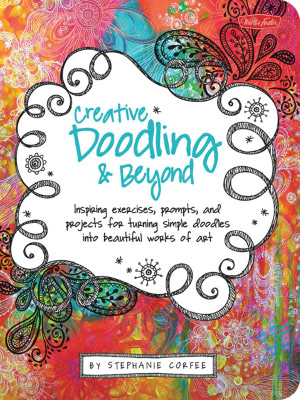
This is one of those books that you read then carry around with you everywhere. You do the exercises, then do them again you get inspired, get ideas…get all the creative juices going.
Finding Your Own Visual Language is a magnificent book. After reading this book and other similar ones this week I’ve learnt four valuable things.
1. Don’t TRY to be original.
2. Accept that some work will have a lot of time and effort put into it but still may not work.
3. Einstein said "in the middle of difficulty lies opportunity".
4. Creative block may just be an important, if not essential, aspect of the creative process. Work with it.
This design book is created by Committed to Cloth artists Leslie Morgan and Claire Benn and Art Cloth Studio artist Jane Dunnewold. Its raison d’etre stems from textiles. Although it illustrates quilting, printed cloth and tapestry weaving more directly it will give huge inspiration to all other weave textile artists too. It’s about getting ideas going, continuing to work and relating those ideas or even just concepts to your practice.
Sixteen very easy to approach visual exercises form the ‘Getting Started’ section of the book to set the maker on a path of artistic and personal discovery. The exercises allow any type of imagery but provides practical ways of breaking down those fixed ideas that lock our brains down and make us unable to continue. These are followed by how to ‘move forward’, examine your progress then going deeper into finding your own visual style or language. I’d give this book 11 out of 10. (I’m not one to reserve the best mark for something else that may come along!- life is short.)
The book is beautifully presented, with illustration and lovely paper and has a spiral binding. I usually don’t like spiral bindings, although I always appreciate the way they lay open so flat, but this one is enclosed within the cover which is neater and more durable.
|

I thought you might like to see my first attempts at working with one of the exercises. This is visual exercise 2 "30 Days of Cutting Stamps". I bought some very cheap PVC erasers and started carving them into designs for stamping. I used lino cut tools but any blade would also work. |

The designs were instant and easy to fill a page and experiment. I’m going to use this design as a basis for peg plan art in a twill weave. |

This is another simple design. |

This is Visual Exercise 1 "Splitting Shapes". I used black paper to draw, cut then split shapes. When happy with the arrangemnent I glued them into position. A very simple exercise which starts the ‘what if I did this or that’ in your head. |

This is the same shape which I scanned into Photoshop, cleaned up then imported into Illustrator. There I was able to trace each path individually and colour them. This is only the start. (Sorry, the book doesn’t go into how to do all this) |
Jun
03
2007
|

|
Peg plan art is really up my alley.
I’m working through The Woven Pixel and having major fun designing painterly peg plans. Using Photoshop allows an artistic approach even though the methods of achieving this never stray far from the structural considerations needed in designing a woven fabric. My peg plans can only be 24 squares wide as this is the limit of shafts available on my loom. However it can be as long as manageable which allows a distinctly rectangular design area to play with.
A peg plan (or lift plan) is a line by line recipe for which shafts to lift or leave behind to achieve a whole design.The more shafts the greater the design potential for patterning in this way.
I’m weaving this design now so hopefully I’ll have some photos of an actual product soon. This is the major downside of being addicted to computers – it leaves less time for actually doing things in the real world!
|
| 24 shaft broken twill pattern using Photoshop to develop the peg plan. |
|

The first line drawn with a paint brush tool. Fluid images can be drawn this way.
|

Line adjusted using the vertical offset filter to match the top and bottom of the line.
|

Finally the line is adjusted with the horizontal offset filter to check the design flow horizontally. A shear filter is added.
|
| |
|

The final peg plan after warp faced and weft faced broken twill patterns have been assigned in Photoshop then transported into Fiberworks sketchpad ready to be used with a threading.
|
| |
Oct
05
2006
Here is my weaving from my previous entry enjoying a bit of outside activity on the clothes line.I’m reasonably happy with it and it will cheer me up on days when my confidence thermometer goes below zero!
This entry is a bit of blog/web pointing and raving…or as I have just learnt ‘cooling’. I’m new as a volunteer category editor at dmoz directory. Cooling is something I can’t do there but I can here on my own space.:-)
When I go looking at great textile blogs like Sara Lamb and The Keyboard Biologist I realise just how much energy I must lack! Theresa, The Keyboard Biologist has a great archive page which allows you to view all of her topics. Have a look at Scarves – really beautiful….and so productive. Her latest entry has knitting in a stainless steel/wool yarn. Forget about sheep – we will have to own mines instead.
Textilers are the most resourceful people. Have you noticed? And interested in anything inventive, functional and beautiful. By way of a very unexpexted hyperlinking adventure I came across Brenda Paternoster’s lacemaking site. Lacemaking is affiliated with weaving in many ways and she provides a great tutorial on making Paper Bobins. I think these will be useful for braiding/kumihimo perhaps – and perhaps a good project to get young students engaged, ready to start their textiles adventures.
As my favourite dye techniqes always include some type of ikat I was particularly interested in how to tie an ikat warp on a frame. This step-by-step tutorial will ensure a great patterned ikat warp, especially if it is taken directly to a backstrap loom and woven. The idea is leave no excuses for shifting the yarn after ikat dyeing. My simple designs shift a little, as seen in this series I am working on – the Passionflower series. I designed a loom controlled supplementary warp at the edges with a false satin for the body. I needed three separately weighted warps for the job, but it was straightforward beyond that.
I’m always impressed when I come across people who pursue their interests in life with creativity and zest. We are all involved with cooking because we have to eat to live. But Cathy at My Little Kitchen puts much more into her exquisite biscuits. Working through Maida Heatter’s Book of Great Cookies Cathy takes mouthwatering artistic photos of her homebaked creations accompanied by ‘reviews’ from her tasting friends. Really lovely.
Lastly [what a long blog entry today], I’m still drawing or trying to. This is a photo of my current project – a portrait of Dave and I at Penzance in England. When I can’t weave, I can always draw. A pencil is even allowed on a plane and is not considered a tool of violence like knitting needles.
Mar
07
2006
The EDM challenge this week to continue with a self portrait induced me to try again. This time with a pen, straight in, no excess measuring and being content to restate over and over. I’ve also drawn this from a photo which changes the dynamics – but I’m happier about this drawing in some ways. The pen medium has something that the pencil doesn’t. I love pencil but somehow my brain and hands handle the drawing subject in different ways.
To me, all aspects of drawing and sketching are interesting. It makes me feel more relaxed about life…sort of having a secret (like chocolate) to look forward to all the time.
Drawing = chocolate?
Mar
04
2006
Portraits of the self are difficult and I think require a real study – doing lots of experiments. Anyway, I enjoyed drawing it and had a splash with the watercolours as well.
Self portraits also expose us in a very public way, which I think prevents me from seeing the subject in an honest way…of course putting this drawing up on a public blog also asks for exposure! There are paradoxes everywhere.
Feb
24
2006
This is something I never thought I’d have a go at drawing. Most of the door knobs in our house are ‘drop dead’ boring. My studio luckily has a beautiful door with an equally suitable door lever. I love the elegance of this door handle and I think I should put more effort into creating beauty in the everyday ordinary items we use continuously every day. Teri drew this exquisite door knob in Arizona.
Door knobs and levers represent entering or locking. They invite or forbid.
Feb
16
2006
Music is so easy to love. Of course I don’t love my piano more than the humans in my life but it is something which gives me alot of pleasure and interesting challenges.
I learnt to play the piano as a child and went as far as the 5th grade but then left it behind for more social activities. When I picked up the piano again about 6 years ago, I was surprised just how much I still ‘knew’..I didn’t have to start from the beginning. It made me think about how important it is to generally expose children to many skills and arts. Everything makes an impression on them and has the potential to enrich their lives and their opportunities.
I’m now in a drumming group and enjoying the djembe, and grappling with the bodhran (Irish Drum). This is about rhythm rather than the melody of the piano and I’m encouraged to enjoy music making without all those sheets of notation.
This drawing of my piano was a test for me in perspective and I’m not really happy with it. I took it into photoshop and tried to bring out the keys more. Anyway I’m learning.
This is an Every Day Matters Challenge.
Feb
08
2006
Working away with the EveryDayMatters group has inspired me to try more drawings. I did this from a photo – It was Christmas Day and we went down to Manning Point in NSW. It is a magical place and I wanted to capture some of that. I’m new to watercolours, so I’m also a bit ‘frightened’ of them…if that’s possible.
I haven’t approached my looms lately [it seems like the ironing is always taunting me] but I’m inspired by Sara Lamb’s site. She has lots of photos of beautiful textiles being woven. She specialises in woven bags.